GOVERNANCE
An integrated governance framework aligned with international standards
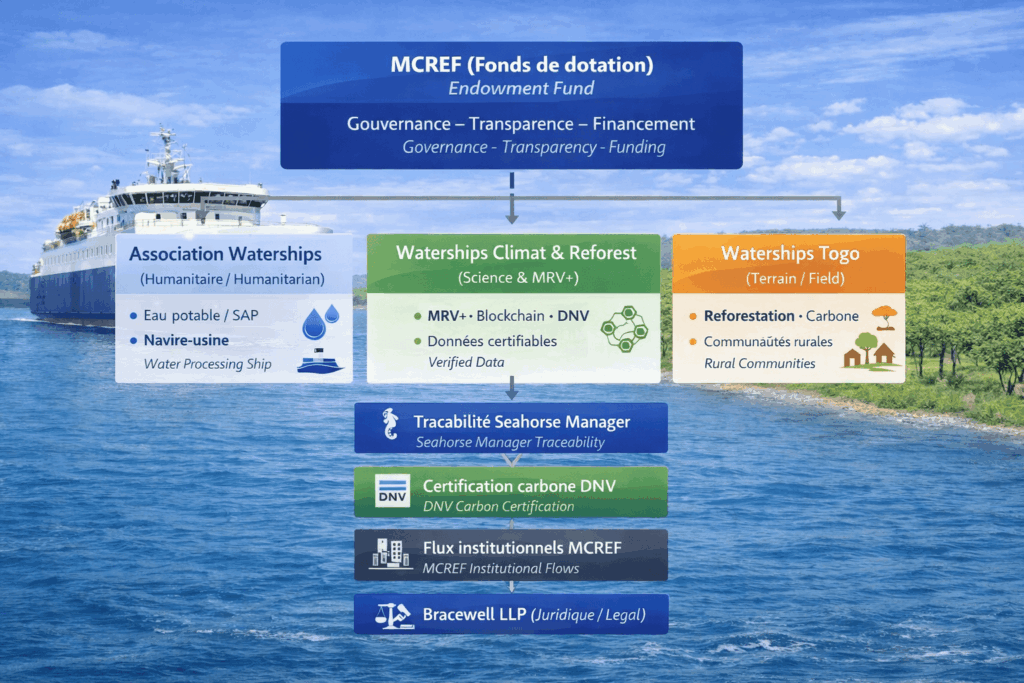
The governance of the Waterships network is built on an institutional architecture designed to ensure mission separation, financial transparency, regulatory compliance and full operational traceability. This architecture is structured around four complementary pillars:
MCREF – Maritime Climate & Resilience Endowment Fund
MCREF is the institutional and nonprofit backbone of the network. As a French endowment fund, it ensures strategic governance, financial transparency, regulatory compliance and full traceability of funds allocated to humanitarian and climate missions. MCREF finances or co‑finances operational entities while guaranteeing a strict separation between nonprofit and commercial activities.
Waterships Association – Humanitarian & Climate Infrastructure
The Waterships Association is the network’s central humanitarian operator. It owns and operates the humanitarian factoryship, deploys emergency hydric solutions and conducts operations in vulnerable regions. It also ensures institutional coherence, coordination with partner States and integration of national entities.
Waterships Climate & Forests (WCF)
WCF is the scientific and climate authority of the network. It defines MRV standards, supervises carbon certification, ensures multi‑country scientific coherence and guarantees compliance with international requirements, including those of DNV. WCF provides the methodological and scientific foundation for hydric, forestry and climate operations.
National entities (e.g., Waterships Togo SAS)
National entities are the field operators of the network. They implement reforestation, agroforestry, ecosystem restoration, community engagement and carbon‑certification programmes. They apply WCF protocols and ensure the collection of certifiable data through the MRV+ system.
🟦 1. MCREF — Maritime Climate & Resilience Endowment Fund
Institutional governance, financial transparency, and regulatory compliance
MCREF is the nonprofit institutional backbone of the Waterships Group. As a French endowment fund, it operates under a strict legal framework that ensures:
transparent financial governance
separation of nonprofit and operational activities
compliance with national and international regulations
traceability of funds allocated to humanitarian and climate missions
long‑term financial sustainability of the Group’s programmes
MCREF provides strategic oversight and ensures that all resources mobilized for missions of general interest are used in accordance with legal, ethical, and institutional standards.
Its responsibilities include:
supervising financial flows and ensuring audit readiness
validating strategic orientations and institutional commitments
ensuring compliance with donor requirements and regulatory frameworks
supporting the development of multi‑country programmes
guaranteeing the integrity of nonprofit governance
MCREF acts as the guarantor of the Group’s institutional credibility.
🟦 2. Waterships Association — Humanitarian & Climate Infrastructure
Operational leadership, institutional representation, and humanitarian governance
The Waterships Association is the operational and humanitarian core of the Group. It is responsible for:
owning and operating the humanitarian factoryship
deploying hydric and humanitarian interventions
coordinating emergency response operations
representing the Group before partner States and public authorities
signing MoUs, framework agreements, and intergovernmental protocols
ensuring institutional coherence across all entities and countries
The Association ensures that all humanitarian and hydric operations are conducted in accordance with:
international humanitarian principles
national regulatory frameworks
scientific and MRV standards defined by WCF
transparency and accountability requirements
It also plays a central role in coordinating with ministries, public agencies, and international organizations.
🟦 3. Waterships Climate & Forests (WCF)
Scientific governance, MRV standards, and climate‑impact integrity
WCF is the scientific and climate authority of the Waterships Group. It ensures that all environmental and climate‑related activities are:
scientifically validated
methodologically consistent
aligned with international certification standards
supported by robust MRV (Measurement, Reporting & Verification) systems
WCF is responsible for:
defining climate‑impact methodologies
supervising carbon‑certification processes
ensuring multi‑country scientific coherence
validating MRV+ protocols and data‑collection frameworks
overseeing environmental, agronomic, and climate modelling
ensuring compliance with DNV and other certification bodies
WCF guarantees the scientific integrity of all climate‑positive programmes implemented by the Group.
🟦 4. National Entities (SAS) — Field Operators
Implementation of reforestation, agroforestry, and ecosystem‑restoration programmes
National entities (e.g., Waterships Togo SAS) are responsible for implementing field operations. Their mandate includes:
reforestation and regenerative agroforestry
ecosystem restoration and watershed rehabilitation
community engagement and local governance
data collection for MRV+ and certification
coordination with local authorities and communities
operational management of field teams and logistics
These entities apply the scientific protocols defined by WCF and operate under the institutional supervision of the Waterships Association and MCREF.
They ensure that programmes are:
locally adapted
socially inclusive
environmentally sustainable
scientifically traceable
aligned with national development strategies
🟦 5. Cross‑entity coordination and institutional coherence
The governance architecture is designed to ensure seamless coordination between:
nonprofit governance (MCREF)
humanitarian operations (Association)
scientific oversight (WCF)
field implementation (national SAS entities)
This coordination is supported by:
shared MRV+ systems
harmonized reporting frameworks
inter‑entity agreements
unified compliance and transparency standards
cross‑entity legal supervision
This integrated model ensures that all activities — from water production to carbon certification — are aligned, traceable, and internationally compliant.
🟦 6. Legal oversight and institutional safeguards
The entire governance system is supported by Bracewell LLP, which provides:
cross‑entity legal supervision
regulatory compliance guidance
drafting and harmonization of inter‑entity agreements
institutional risk management
legal support for international partnerships and MoUs
This legal oversight ensures that the Group’s governance architecture remains robust, compliant, and aligned with international best practices.
🟦 7. Principles guiding the governance model
The Waterships governance framework is built on the following principles:
Transparency — clear reporting, traceability, and accountability
Scientific integrity — adherence to WCF standards and MRV+ protocols
Institutional coherence — alignment across all entities and countries
Nonprofit governance — strict separation of missions of general interest
Operational excellence — efficient, scalable, and certifiable interventions
International compliance — conformity with global norms and certification frameworks
Long‑term sustainability — programmes designed for durable impact