COP 21 – Article 6.2
ARTICLE 6
Article 6 of the Paris Agreement enables international cooperation to tackle climate change and to unlock financial support for developing countries.
There are three components to Article 6:
- Article 6.2: Provides accounting and reporting guidance for Parties to use internationally transferred mitigation outcomes towards their nationally determined contributions (NDCs).
- Article 6.4: Establishes a new UNFCCC mechanism which can be used to trade high-quality carbon credits.
- Article 6.8: Provides opportunities for non-market-based cooperation for enhancing climate action.
The groundwork for carbon markets and non-market approaches laid out at COP26 in Glasgow continues to be fine-tuned.
This work is being done at annual meetings of the Parties to the Paris Agreement (CMA) and biannual meetings of the Subsidiary Body for Scientific and Technological Advance (SBSTA), as well as through intersessional work. In the case of the Article 6.4 mechanism (also known as the Paris Agreement Crediting mechanism), operationalization is being progressed by the work of the mechanism’s Supervisory Body.
Read the UN Climate Change Quarterly Update: Q4 2025 for updates related to Article 6 of the Paris Agreement, highlighting key developments and casting ahead. Click here for previous quarterly reports.
ARTICLE 6.2
What is Article 6.2 of the Paris Agreement?
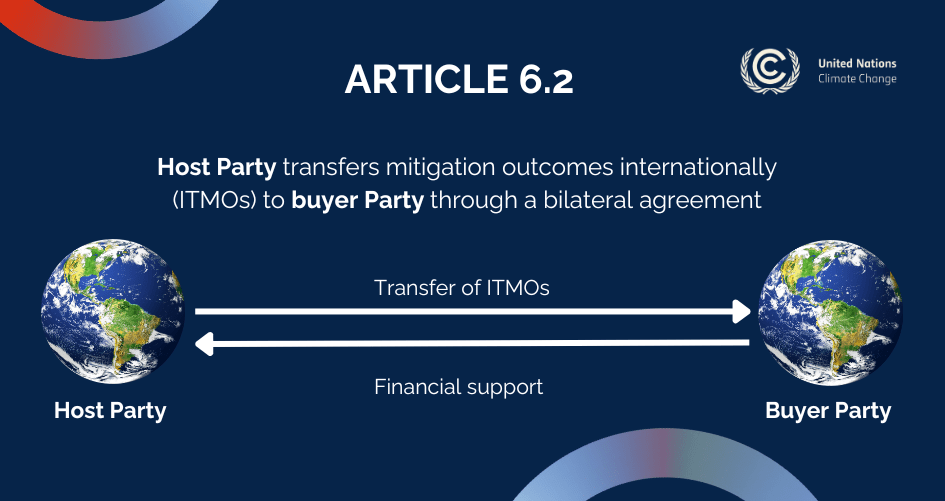
Under Article 6.2 of the Paris Agreement, countries can trade emissions reductions bilaterally.
In other words, Article 6.2 enables a host country to sell units to a buyer country, in exchange for investments, support for capacity building, and access to technologies not available through domestic resources. The buyer country purchases these units, known as Internationally Transferred Mitigation Outcomes (ITMOs), to address any gaps in meeting its own climate goals.
What is Article 6.2 Ambition Dialogue?
Article 6.2 Ambition Dialogue offers Parties a space for peer-to-peer discussions outside of the formal negotiation setting on fundamental questions regarding the role and function of Article 6.2 cooperative approaches to delivering on the ambition of the Paris Agreement. To find out more, click here.
What is Article 6 Technical Expert Review?
Under Article 6.2 of the Paris Agreement, countries engaging in cooperative approaches must submit detailed reports, which are reviewed through the Article 6 Technical Expert Review (TER) process. Coordinated by the secretariat and guided by CMA decisions, this review ensures transparency and accuracy while remaining nonintrusive and respectful of national sovereignty. To find out more, click here.
What is CARP?
To facilitate the sharing of reports and information under Article 6.2, countries agreed to set up a Centralized Accounting and Reporting Platform (CARP).
This platform provides:
- Guidance on how to submit information and a list of frequently asked questions
- Templates for submissions
- A list of reports by submitted by participating countries
- A list of authorizations
What is the International Registry?
The international registry is a system managed by the UNFCCC secretariat that tracks carbon credits known as internationally transferred mitigation outcomes (ITMOs). It is available to countries and authorized entities and is part of the centralized accounting and reporting platform (CARP). The registry tracks ITMOs from issuance to use or transfer and also helps automatically fill in required reporting information. To find out more, click here.